class 9 math exercise 11.2 || class 9 exercise 11.2 || class 9 maths construction exercise 11.2 || class 9 maths chapter 11 exercise 11.2 || class 9 maths construction exercise 11.2 || ncert maths class 9 chapter 11 solutions || rd sharma class 9 construction || class 9 maths exercise 11.2 solution || exercise 11.2 class 9
Exercise 11.2
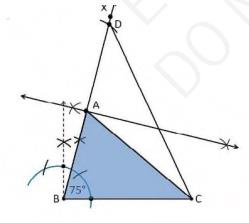
1. Construct a triangle ABC in which \( \mathrm{BC}=7
\mathrm{~cm}, \angle \mathrm{B}=75^{\circ} \) and \( \mathrm{AB}+
\) \( A C=13 \mathbf{~ c m} \).
Answer
The steps to draw the triangle of given measurement is as
follows:1. Draw a line segment of base \( \mathrm{BC}=7 \mathrm{~cm} \)
2. Measure and draw \( \angle B=75^{\circ} \) and draw the ray \( B X \)
3. Take a compass and measure \( \mathrm{AB}+\mathrm{AC}=13 \mathrm{~cm} \).
4. With B as centre and draw an arc at the point be D
5. Join DC
6. Now draw the perpendicular bisector of the line BD and the intersection point is taken as A .
7. Now join \( A C \)
8. Therefore, ABC is the required triangle.
class 9 math exercise 11.2 || class 9 exercise 11.2 || class 9 maths construction exercise 11.2 || class 9 maths chapter 11 exercise 11.2 || class 9 maths construction exercise 11.2 || ncert maths class 9 chapter 11 solutions || rd sharma class 9 construction || class 9 maths exercise 11.2 solution || exercise 11.2 class 9

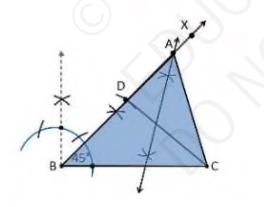
2. Construct a triangle ABC in which \( B C=8 \mathrm{~cm},
\angle B=45^{\circ} \) and \( A B- \) \( \mathrm{AC}=3.5
\mathrm{~cm} \).
Answer
The steps to draw the triangle of given measurement is as
follows:1. Draw a line segment of base \( \mathrm{BC}=8 \mathrm{~cm} \)
2. Measure and draw \( \angle \mathrm{B}=45^{\circ} \) and draw the ray BX
3. Take a compass and measure \( \mathrm{AB}-\mathrm{AC}=3.5 \mathrm{~cm} \).
4. With \( B \) as centre and draw an arc at the point be \( D \) on the ray \( B X \)
5. Join DC
6. Now draw the perpendicular bisector of the line \( C D \) and the intersection point is taken as A.
7. Now join \( A C \)
8. Therefore, ABC is the required triangle.
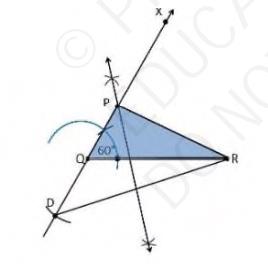
3. Construct a triangle \( P Q R \) in which \( Q R=6
\mathrm{~cm}, \angle Q=60^{\circ} \) and \( P R- \) \( \mathbf{P
Q}=\mathbf{2 c m} \).
Answer
The steps to draw the triangle of given measurement is as
follows:1. Draw a line segment of base \( \mathrm{QR}=6 \mathrm{~cm} \)
2. Measure and draw \( \angle \mathrm{Q}=60^{\circ} \) and let the ray be QX
3. Take a compass and measure \( \mathrm{PR}-\mathrm{PQ}=2 \mathrm{~cm} \).
4. Since \( \mathrm{PR}-\mathrm{PQ} \) is negative, QD will below the line QR .
5. With Q as centre and draw an arc at the point be D on the ray QX
6. Join DR
7. Now draw the perpendicular bisector of the line DR and the intersection point is taken as P .
8. Now join PR
9. Therefore, PQR is the required triangle.
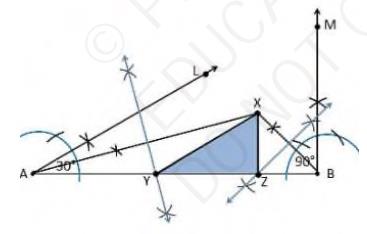
4. Construct a triangle \( X Y Z \) in which \( \angle
Y=30^{\circ}, \angle Z=90^{\circ} \) and \( X Y+ \) \( \mathbf{Y
Z}+\mathbf{Z X}=11 \mathrm{~cm} \).
Answer
The steps to draw the triangle of given measurement is as
follows:1. Draw a line segment AB which is equal to \( \mathrm{XY}+\mathrm{YZ}+\mathrm{ZX}=11 \mathrm{~cm} \).
2. Make an angle \( \angle \mathrm{Y}=30^{\circ} \) from the point A and the angle be \( \angle \mathrm{LAB} \)
3. Make an angle \( \angle Z=90^{\circ} \) from the point \( B \) and the angle be \( \angle M A B \)
4. Bisect \( \angle \mathrm{LAB} \) and \( \angle \mathrm{MAB} \) at the point X .
5. Now take the perpendicular bisector of the line XA and XB and the intersection point be Y and Z respectively.
6. Join XY and XZ
7. Therefore, XYZ is the required triangle
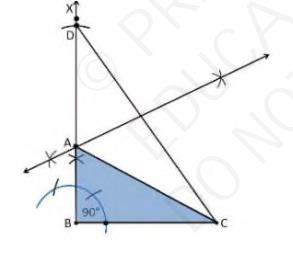
5. Construct a right triangle whose base is 12 cm and sum of its
hypotenuse and other side is 18 cm .
Answer
The steps to draw the triangle of given measurement is as
follows:1. Draw a line segment of base \( \mathrm{BC}=12 \mathrm{~cm} \)
2. Measure and draw \( \angle B=90^{\circ} \) and draw the ray \( B X \)
3. Take a compass and measure \( \mathrm{AB}+\mathrm{AC}=18 \mathrm{~cm} \).
4. With B as centre and draw an arc at the point be D on the ray BX
5. Join DC
6. Now draw the perpendicular bisector of the line \( C D \) and the intersection point is taken as A .
7. Now join \( A C \)
8. Therefore, ABC is the required triangle.